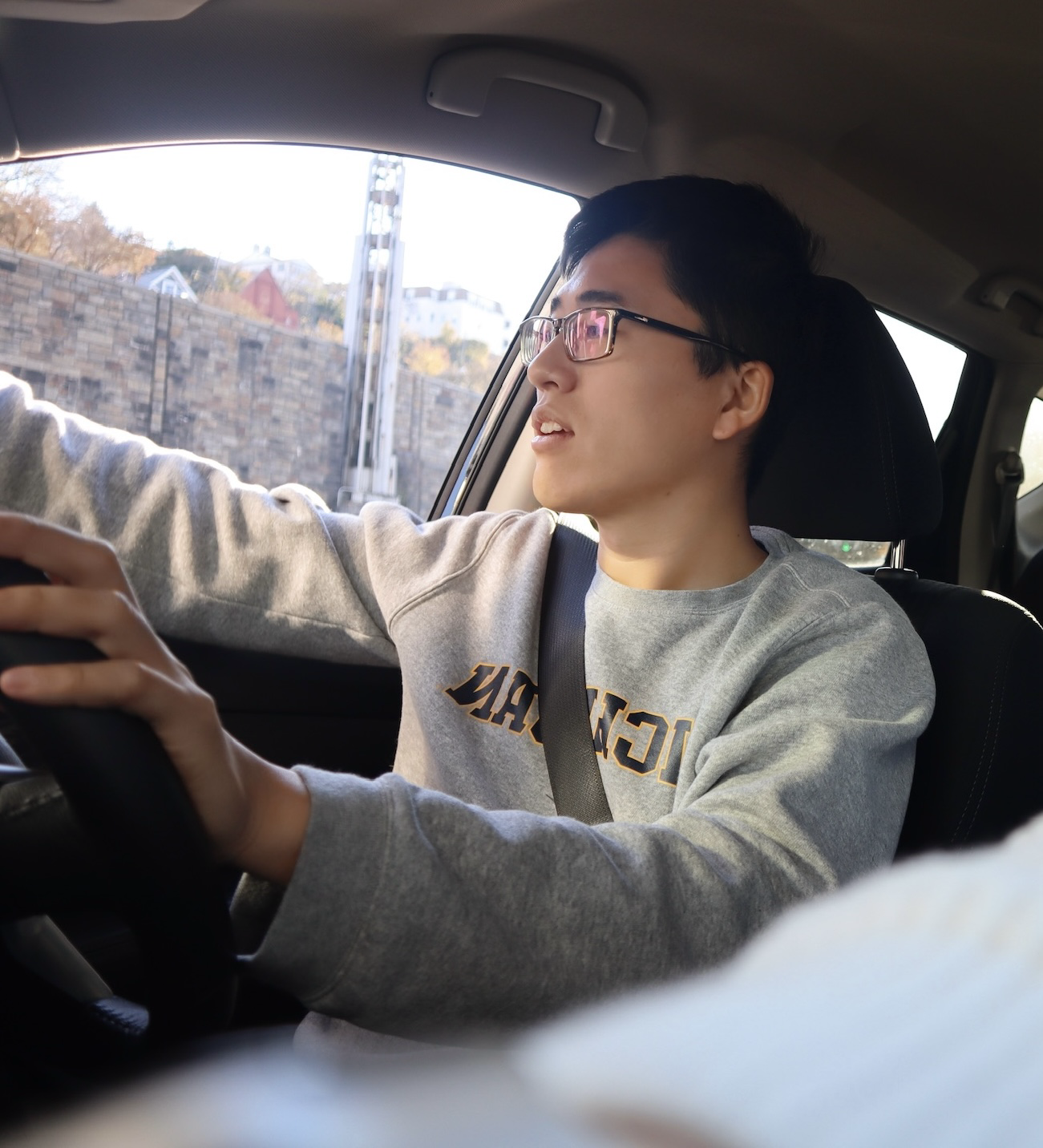
About Me
I am a third-year PhD student in Electrical and Computer Engineering at the University of Michigan, advised by Jeffrey Fessler and Qing Qu (DeepThink Lab).
Research Interest
My research interests focus on generative models (especially diffusion models), representation learning and agentic AI, with applications to scientific domains, e.g., data assimilation and computational imaging. Recently, I have started exploring video generation and world models, as I find these areas share foundational similarities with my previous work.
Education
- University of Michigan, Ph.D. in Electrical Engineering and Computer Science
- University of Michigan, M.S. in Electrical Engineering and Computer Science
- Tsinghua University, B.S. in Instrument Science and Technology (Primary)
- Tsinghua University, Bachelor of Business Administration (Secondary)
News
- [Sep 2026] I am honored to receive the Riethmiller Fellowship.
- [Sep 2026] Our paper “MCLR: Improving Conditional Modeling in Visual Generative Models via Inter-Class Likelihood-Ratio Maximization” is accepted at NeurIPS 2026 main track.
- [Sep 2026] Our work “Backward-Consistent Diffusion Sampling for Sparsely Observed Inverse PDE Problems” is accepted at NeurIPS 2026 workshop (STODY).
- [May 2026] Our paper “Imaging-101: Benchmarking LLM Agents for Scientific Computational Imaging” is accepted at ICCP 2026 (Oral).
- [May 2026] Four papers are accepted at ICML 2026 workshop (FoGen): ForcingDAS (Spotlight), ICR, MCLR (Oral), and DFD.
- [May 2026] I have joined Bytedance as a research scientist intern (Seed, GenAI for Science), working on agentic scientific discovery.
- [Apr 2026] Our paper “Evaluating the Representation Space of Diffusion Models via Self-Supervised Principles” is accepted at ICML 2026 (Poster) main track.
- [Mar 2026] Our recent work “Deep Residual Learning Framework for Scatter Estimation in SPECT Imaging of Alpha Emitters” is accepted at SNMMI 2026.
- [Sep 2025] Our paper “FlowDAS: A Stochastic Interpolant-based Framework for Data Assimilation” is accepted at NeurIPS 2025 main track.
Beyond Work
I have two adorable kittens, Rainier and Mia! In my spare time, I enjoy driving around, playing and watching soccer. I’m a huge fan of Leo Messi 🐐.